
Optimizing Edge Deployment in Manufacturing and Industrial Automation
It's easy to overlook the need for more and more processing power. After all, when you hear news about data centers and cloud computing, usually the involved parties are multi-billion dollar companies like Apple, Amazon, Google, and Microsoft. But in today's age, nearly all businesses need and already use some level of computing to operate efficiently.
In manufacturing and industrial automation, computing capacity is essential whether it comes to real-time monitoring, predictive maintenance, or CNC machines.

However, this doesn't mean all businesses need to invest into a cloud service. While cloud providers will offer reliable and high performing computing processes over the internet, the biggest issue with this computing model is distance and latency. For manufacturing, real-time processing is key.
How do you achieve real-time processing?
The counterpart to cloud computing is edge computing!
Imagine a bustling city intersection with thousands of vehicles moving in different directions. Now, picture what would happen if all traffic signals were controlled from a distant headquarters miles away. Delays. Accidents. Chaos. The disconnect caused by the distance makes it hard for the HQ to properly manage the traffic. Similarly, in the world of industrial automation, traditional cloud computing can act like this remote headquarters, struggling to process data fast enough for real-time decisions.

This is where edge computing steps in, acting as an on-site traffic cop, managing data flow instantly and efficiently. Edge computing does this by bringing data processing closer to the source, thereby reducing latency and ensuring critical decisions happen instantly.
Benefits of edge computing in manufacturing and industrial spaces
Edge computing is a game changer. Here are some of their immediate benefits:
- Faster decision making — machines can analyze sensor data locally rather than waiting for cloud servers to respond, leading to quicker adjustments in production lines.
- Reduced downtime with predictive maintenance — edge-enabled sensors detect wear and tear before failure occurs, allowing businesses to address maintenance proactively rather than reactively.
- Enhanced security — sensitive manufacturing data stays within the facility instead of constantly being transmitted over external networks, reducing cyberattack risks.
- Operation efficiency — smart automation systems at the edge can dynamically adjust power consumption, optimize workflow, and improve resource management.
Challenges in Industrial Networking (and How Patch Panels Solve Them)
Integrating edge computing systems into an existing IT infrastructure comes with challenges, particularly when it comes to managing complex network connections in an industrial environment. With edge computing increasing the number of connected devices on factory floors, network complexity grows exponentially. Machines, sensors, and industrial IoT (IIoT) devices must communicate seamlessly while handling high volumes of data. Some of these challenges involve:
- Cable management overload — a modern industrial facility has thousands of network cables connecting various devices. Without organization, this becomes a tangled mess, making troubleshooting a nightmare.
- Signal interference & connectivity issues — harsh industrial environments filled with electromagnetic interference (EMI) can degrade signal quality, leading to unreliable network performance.
- Scalability concerns — as manufacturers expand and adopt new technology, their network must be flexible enough to accommodate growth without costly overhauls.
Patch panels provide the structured cabling solution that industrial IT networks desperately need.
- Improved organization and troubleshooting — patch panels neatly consolidate all network connections, making it easy to label, manage, and identify cables when problems arise.
- Stronger signal integrity — shielded patch panels help minimize interference, ensuring stable connectivity between edge computing devices and network servers.
- As new machines and devices are added, patch panels allow seamless expansion without rewiring the entire facility.
As manufacturing and industrial automation industries move toward smarter, data-driven operations, edge computing is becoming essential for maintaining efficiency, security, and reliability. However, without a well-structured network infrastructure, the advantages of edge computing can be lost in a maze of disorganized cabling and connectivity issues.
By utilizing patch panels alongside edge computing, manufacturing can ensure a future-proof network that is not only fast and intelligent but also organized, scalable, and reliable. Investing in both technologies will provide a competitive edge, keeping industrial operations running smoothly in an increasingly connected world.
What does the R.J. Enterprises patch panel offer?
Since 1984, R.J. Enterprises has been developing IT networking solutions for all sorts of companies in the telecommunication and computer networking space. One of our most notable product lines is the RJ-HDPP, or also known as the R.J. Enterprises High Density Patch Panels.
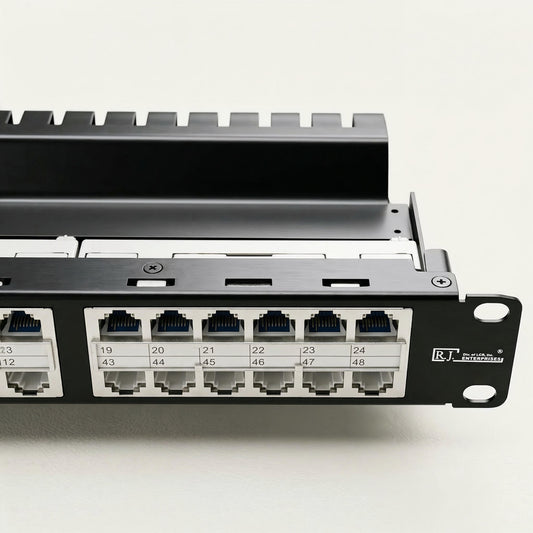
High Port Density: 48 ports in 1U vs 24 ports in 1U
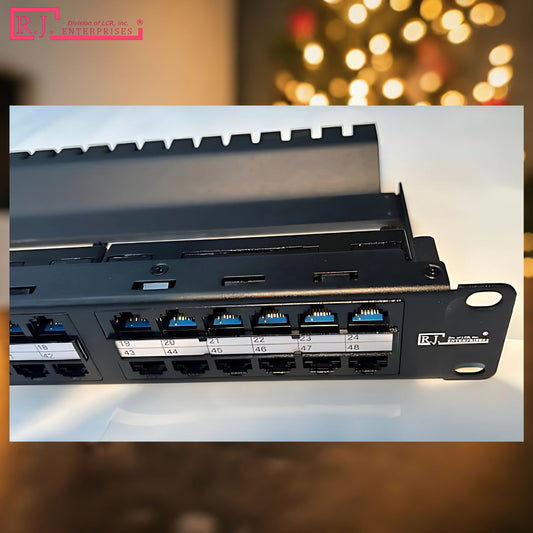
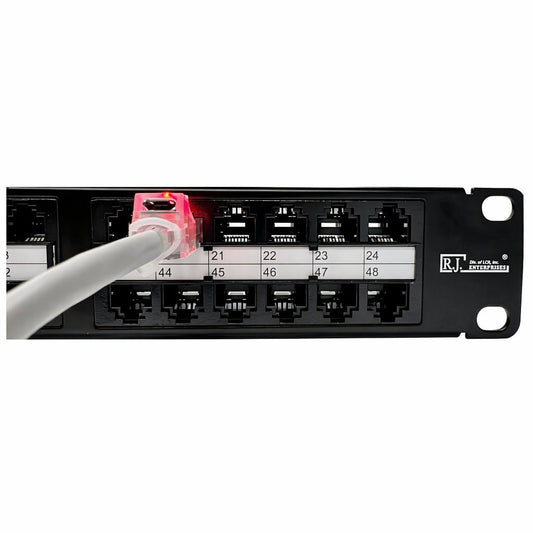
Our high density patch panels offer 48 ports (2x the number of ports found in traditional 24-port patch panels), within a single rack unit. The high port-density's advantage is reflected in optimizing space-efficiency in constrained spaces. In large data centers where every inch is scrutinized, our high density patch panel offers up to 50% more space. In edge computing especially, our 1U HDPP is able to offer a higher value due to increased attention placed on space.
"Plug-and-Play" Installation
Technology is an ever-changing landscape, which is why it's also a prudent and strategic decision to continuously perform maintenance on your networks. However, maintenance can be an extremely time-consuming task when it comes to reinstalling and performing checks on your patch panels and cable connections. When it comes to punch down patch panels, each conductor of a twisted pair cable (usually 8 wires per cable) must be carefully positioned and punched down into the insulation displacement connector slots. Now multiply this by hundreds and thousands of cables and your task has ballooned into a herculean effort, even for professionals.
At R.J. Enterprises, our HDPP offers a simple "plug-and-play" installation where pre-installed RJ45 ports allow you to automatically terminate your wires — saving you up to 90% more time.
PoE+ and PoE++ Support
Power over Ethernet allows cables to transmit power between devices, while also still carrying out their function in transmitting data. When it comes to increasing space efficiency, reducing the number of redundant cables is important. With PoE support on our patch panels, you are able to save additional space and organize your cabling more efficiently by removing the need for electrical cords.
High Speeds of 10 Gbps and Shielding
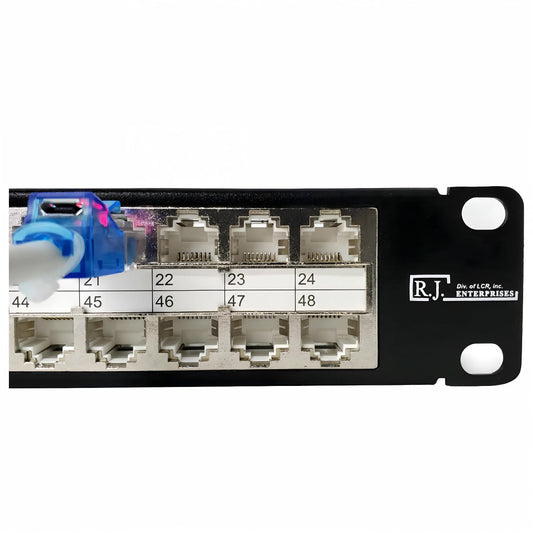
Our HDPP line also has the ability to support 10 Gbps speeds, allowing you to maximize performance or prepare for future scalability. This line also features shielding technology that will protect your network from alien crosstalk and EMI.