
Shielded vs Unshielded Keystone Jacks: When You Actually Need STP
Share
Walk into any contractor forum and you'll see the same question: "Do I really need shielded keystone jacks for this job?" The answer is almost always "it depends" — and that's not helpful when you're standing in the supply aisle deciding what to buy.
Here's a straight answer based on 40+ years of making both.
The short version
You need shielded (STP) when:
- The install is in a server room, data closet, or near rack equipment
- Cables run parallel to electrical conduit, fluorescent ballasts, or large motors
- Industrial environment with heavy machinery
- You're running 10 Gbps over the full 100 meter Cat6A distance
Unshielded (UTP) is fine when:
- Residential install
- Standard office or small commercial
- Cables run through normal walls and ceilings
- No major EMI sources nearby
If you're not sure, the cost difference is small enough that shielded is the safer bet for any commercial install. For residential, unshielded is fine 95% of the time.
What shielding actually does
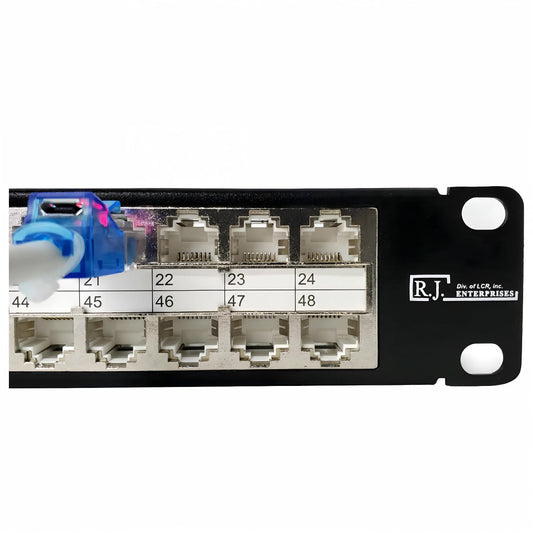
A shielded keystone jack has a metal foil or braid around the contacts. Its job is to block electromagnetic interference (EMI) from corrupting the signal — kind of like a Faraday cage for your data.
When EMI hits an unshielded cable, you get crosstalk and signal degradation. At 1 Gbps speeds with short runs, you'll probably never notice. At 10 Gbps over 90+ meters, even small amounts of EMI can drop packets and tank performance.
For more on this, our crosstalk definition guide explains the physics.
When shielding actually matters
The biggest mistake we see is contractors over-buying shielded for residential jobs (waste of money) or under-buying for industrial (signal problems six months later).
Here's where shielded is genuinely worth it:
Server rooms and data closets. Lots of equipment generating EMI. Cables packed tight together. High data rates. Shielding helps a lot.
Industrial settings. Factory floors, warehouses with heavy machinery, anywhere you've got motors or VFDs nearby. Unshielded will give you intermittent problems that are hell to troubleshoot.
Near electrical conduit. Code says you need 12 inches of separation between data and power. In real-world installs, that's not always possible. Shielded gives you a buffer.
10 Gbps over long Cat6A runs. At the upper end of Cat6A's range, shielding can be the difference between working and not.
When you're paying for nothing
Don't waste money on shielded for:
- Single-family homes with normal wall runs
- Offices where cables stay inside drywall
- Short runs under 50 feet at 1 Gbps
- Anywhere there's no EMI source within 12+ inches
Unshielded jacks at our price point (RJ-EC-01, RJ-EC-04) deliver clean signal in standard conditions. No need to overpay.
Grounding matters as much as the jack
One thing most articles skip: shielded jacks only work if the shield is properly grounded. If you install shielded keystones but don't bond the shield to ground at one end, you've essentially just bought expensive unshielded jacks. Worse, ungrounded shields can act as antennas and make interference worse.
Always ground at one end (usually the patch panel side). Don't ground both ends — that creates ground loops.
Our shielded options
If you need shielded for your job:
- RJ-EC-02 — Cat6A shielded keystone jack with built-in metal cable strain relief. For new runs in EMI environments.
- RJ-EC-03 — Cat6A shielded coupler. For pass-through and extending existing Cat6A runs.
- RJ-EC-05 — Cat6 shielded coupler. For shielded pass-through on Cat6 runs.
All three are TIA certified, UL listed, and 10Gbps capable. Bundle pricing starts at $10 for 2 plates.
The bottom line
Shielding isn't a "premium tier" — it's a tool for specific conditions. Use it when there's actual EMI to block. Skip it when there isn't. Your customers will thank you for not overcharging them, and your work won't suffer from underspeccing it.